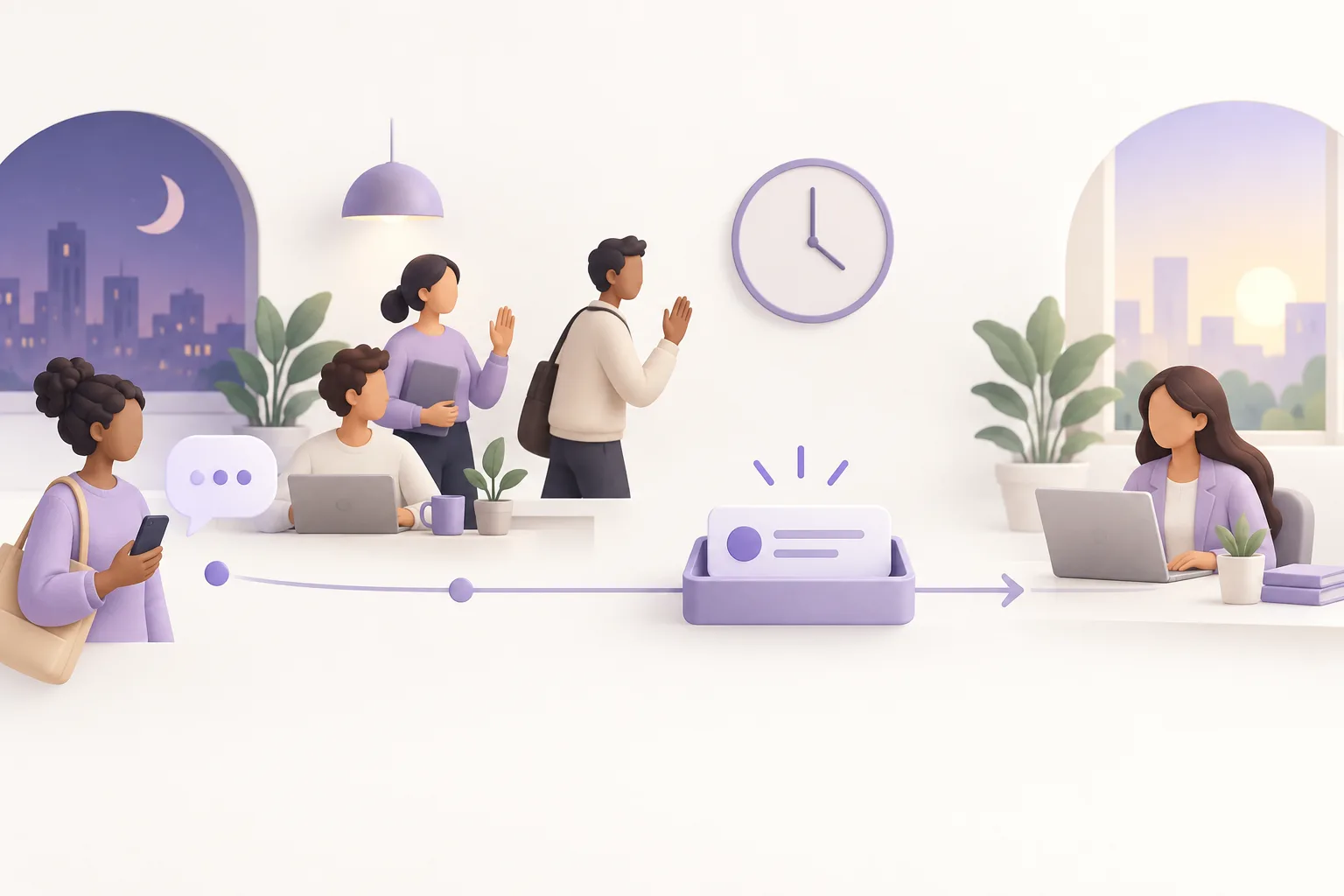
An away message can acknowledge contact. Service resumes reliably only when published hours, a visible queue and next-shift ownership agree.
Start with a promise the team can keep
A customer writing after hours does not need an impossible promise of instant service. They need confirmation that the message has arrived, a realistic next response window, and a real path for urgent issues if one exists. Your business-profile hours, website, automated text and human replies should tell the same story. If your team works weekdays only, say so. “We will be with you shortly” is misleading when the queue will not be opened until tomorrow.
The official WhatsApp Business guidance says a business profile can display business hours. The app can schedule an away message continuously, for a custom period, or outside the hours set in that profile. Before you write the copy, check time zone, public holidays, weekends and locations with different schedules. One global message may be inaccurate for a regional team or store.
Treat the automated receipt, first useful human reply and next update as different commitments. The receipt helps the customer understand what happens next, but it should not stop the human first-response clock or close the conversation. The guide to service-level promises by channel explains how to document start and stop events, calendars, pauses and breaches without turning a historical average into a public guarantee.
Separate app away messages from Platform rules
In the WhatsApp Business App, away messages are a configurable way to explain unavailability. The official instructions describe schedules and recipient selection and note that the device must have an active internet connection to send them. Test from an external number and verify what arrived. Switching on a setting does not prove every intended recipient was covered, especially when recipient exclusions or a connection failure are involved.
The WhatsApp Business Platform has a separate messaging constraint. Under the official Business Messaging Policy, a business can reply without a template within 24 hours of the user’s last message; outside that customer-service window, an approved template is required. This technical window is not your staffing schedule. A customer may write late at night while the window is open, although your team has honestly promised a human reply only on the next shift.
If your next-shift follow-through might happen after the technical window closes, plan the appropriate approved template and permissions before promising that contact. Do not route around the policy through another number, treat an away message as marketing consent, or confuse a Platform template with an App away message. Our template governance guide explains why each use case needs an owner, review and purpose.
Carry the queue across a shift change
An automatic message is an entrance, not a queue. Every after-hours conversation should retain arrival time, channel, known intent, preliminary priority, next action time and the team that will take ownership. If an agent had already promised a return call, preserve that commitment when the customer writes again at night. Do not create a second case simply because there is a new message. Our guide to promised follow-through covers duplicate-safe reminders and rescheduling.
At shift start, review at-risk and overdue commitments first. Then order the remaining work by impact and age rather than just the latest message. Quick questions are easy to clear, but they should not bury a sensitive exception. Decide who watches unassigned work, who reassigns absent staff and when a human supervisor intervenes. If an on-call rotation exists, publish only the incident types that rotation actually covers.
Waiting needs a named reason and a next action. “Waiting for customer” fits only when the team has asked for specific information; waiting for your own next shift is not the customer’s responsibility. A transfer should carry history, deadlines and what has already been said. The department routing guide shows how to move work without hiding it in personal inboxes.
Test the journey from the customer side
A good notice has four parts: the team is currently unavailable, the next staffed window, what will happen to the request and an emergency route only if it is genuinely supported. For example: “We received your message. Human support returns tomorrow at 9 a.m. Brasília time. Your request will remain in our queue and we will reply here. For a critical incident covered by your support agreement, use the emergency channel in that agreement.” Adapt the text to the real schedule; remove the last sentence if there is no on-call service.
Send test messages shortly before closing, after closing, on a holiday and when the next shift opens. Check that the notice is sent once, the time is correct, the conversation lands in the right queue and a person replies within the published window. Also simulate a disconnected device, a reassignment and a request with an existing promised update. The admin screen alone is not proof: inspect what the external customer number actually receives.
Measure after-hours arrivals, successful automated receipts, next-shift human first replies, unowned cases and overdue commitments separately. Review real examples weekly. If the notice is accurate but the queue grows, the issue is capacity, prioritization or shift handoff, not a missing sentence in the automation. Fix that workflow before extending published hours.
- Published hours and time zone agree across channels
- Away message tested from an external number
- Automation is not counted as human response or resolution
- After-hours queue has a next-shift owner
- Emergency routing matches actual on-call coverage
- Platform window and templates reviewed
- Earlier promises remain linked without duplicate cases
- Holiday, weekend and connectivity tests pass
- Human first replies and unowned cases are measured