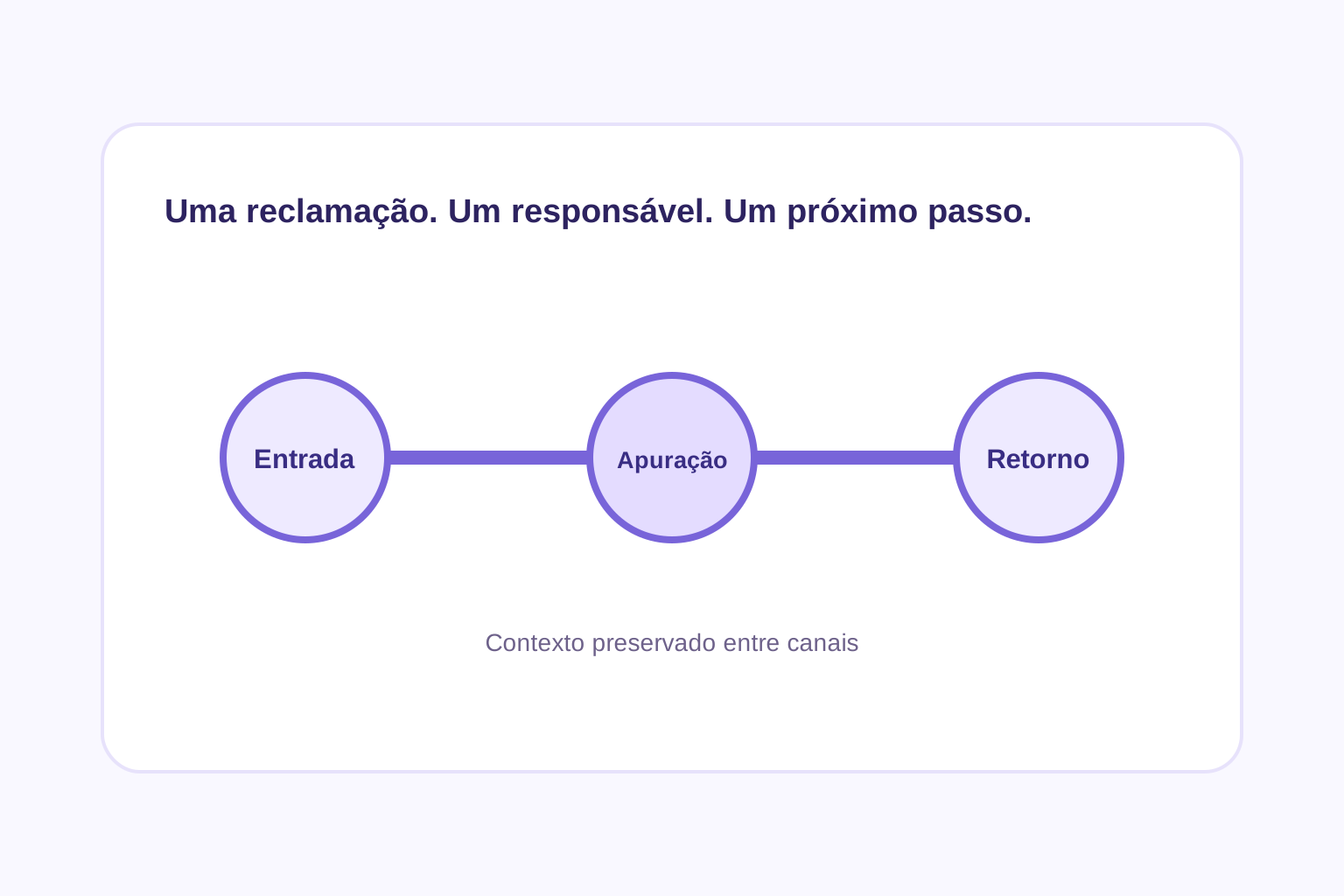
Treat a complaint as a case followed from beginning to end, not just another message to answer. Record what the customer reports, acknowledge receipt without promising an unverified fix, assign an owner, investigate with the right teams, and agree on the next update. Close only when the response and evidence are recorded. If the customer moves from WhatsApp to email or a public channel, preserve the timeline without merging identities on a weak match.
A workable flow has six states: received, triaged, under investigation, waiting on a dependency, response sent, and closed after review. Every state needs an owner, a next-action date, and visible history. Track initial response separately from resolution time. If a case involves safety, sensitive data, or a specific legal obligation, route it to the qualified team. This is an operational framework, not legal advice.
Capture the case and confirm what arrived
A complaint may start as a short request, acquire a photograph in WhatsApp, and end as a detailed email. Create one case record with the originating channel, conversation identifier, the customer's account in their own words, the product or service involved, authorized documents, reported impact, and first-contact time. Mark what the team observed, what remains an unverified allegation, and what has already been done. That distinction prevents defensive replies and duplicate investigations.
The public ISO 10002:2018 overview describes complaints handling as a process covering operation, review, and improvement for organizations of different sizes. It does not mean every business holds certification or that one response deadline fits every context. Use its published scope to build a process proportional to your own risk and volume.
Acknowledge receipt with a case reference when possible. Tell the customer who will follow up, what information is still needed, and when the next update will come. Do not make them repeat the full story merely because the case changed channels. Before joining two conversations, validate identity and access: similar messages do not establish that two accounts belong to one person. The guide to identity across channels explains why false merges are dangerous.
Set priority by impact and assign accountable ownership
Keep triage distinct from completion. Triage asks whether there is an immediate safety risk, service interruption, disputed charge, sensitive information, vulnerable customer, or already missed commitment. Severity determines who reviews the case and how often it should be updated. An angry message is not necessarily more serious than a quiet failure; use observable criteria and allow human review.
Name a person or team accountable for the case even when another department must investigate. Ownership does not mean doing every task alone. It means following dependencies, requesting an internal answer, and keeping the customer informed. A transfer should include the complaint, actions tried, evidence, unresolved decision, and next deadline. Require acceptance from the receiving owner before the first owner lets go. Our escalation guide separates urgency, warning, and actual escalation.
Avoid promising resolution at a time controlled by an external supplier or an investigation that has not begun. Promise a controllable update instead: tell the customer what you know by an agreed time even if the root cause remains open. Record that commitment, its owner, time zone, and what happens if the deadline is at risk. The guide to promised customer updates helps prevent competing reminders and forgotten commitments.
Investigate, respond, and retain the evidence
During investigation, assemble a timeline of the initial request, system events, conversations, internal actions, and each team's response. Request only necessary information. If the issue concerns personal-data rights, a generic support reply should not automatically replace the privacy process. Brazil's data protection authority explains data-subject rights and the controller's role. Route such a request through the appropriate process and owner rather than improvising a legal conclusion in the service inbox.
The final answer should distinguish what was investigated, what was or was not confirmed, what action was taken, what remains open, and how the customer can challenge or add information. If the problem cannot yet be corrected, say so plainly and give the next real milestone. Do not invent a cause, compensation, deadline, or approval. When an operational fix has been made, verify it in the system or with the accountable team before telling the customer it is complete.
Some complaints arrive through platforms with their own workflow. Consumidor.gov.br describes its official process: the complaint is filed, the company responds, and the consumer can assess that response. That platform's rules should not be copied as a universal service level for private conversations. If your organization participates in a public channel, track its deadlines and permissions separately. Coordinate the public response with the internal investigation and keep private information out of public replies.
Close the loop without hiding difficult cases
A case is not resolved merely because an outbound message exists. Define closure: final answer sent, promised action completed, and evidence retained; when appropriate, customer confirmation. Distinguish administrative closure from acceptance of the outcome. If the customer disagrees or returns with the same issue, reopen or link the new contact after an identity check. Do not erase the first attempt to improve a metric.
Review a weekly sample by complaint reason, channel, severity, and outcome. Measure time to the first useful response, whether promised updates happened on time, age of open investigations, repeat cases, and the dependencies that cause delay. Display counts with denominators; a short average can conceal a few old, high-impact cases. Use recurring reasons to improve instructions, processes, and product, not to automatically blame the agent who first received the message.
A small team can start with one queue and a few states. A larger operation may need specialists and formal review. In either case, test the process using one real and one simulated case: intake on two channels, ownership transfer, a threatened deadline, an incomplete answer, and reopening. If a step depends on one person's memory or an invisible spreadsheet, the process still has a gap worth fixing.
- Preserve the report, channel, date, identifier, and relevant evidence without collecting unnecessary data.
- Distinguish observed facts from allegations and investigative hypotheses.
- Show one current owner, one next action, and one update date.
- Route safety, privacy, and channel-specific obligations to qualified owners.
- Transfer with context and acceptance before removing the first owner.
- Check the final answer against completed actions and still-open commitments.
- Record closure, disagreement, and reopening as different outcomes.
- Review old and severe cases alongside aggregate rates.