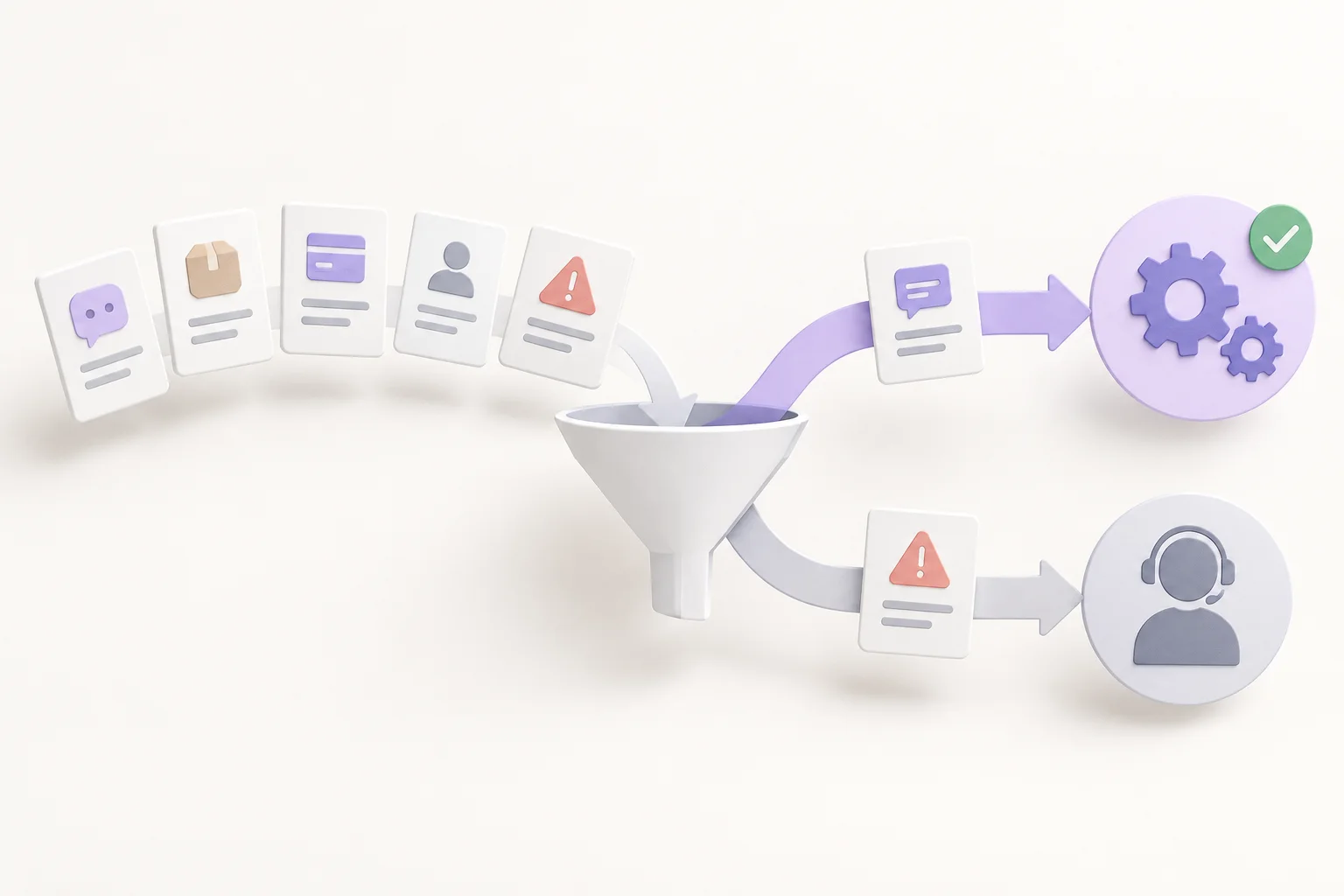
The best first automation is not the most impressive one. It is repetitive, well defined, independently verifiable, and easy to return to a person when an exception appears.
Map tasks instead of automating an entire job
Before choosing a tool, list the actual work between a customer message and an outcome. Separate intake, identification, classification, source lookup, drafting, action, delivery confirmation, and record keeping. A job contains many judgments; a task has a defined start, finish, and observable evidence.
Review a recent conversation sample and count frequency, time, variation, and exceptions. Record the inputs, authoritative system, approval owner, and proof that the customer received the intended result. This prevents an impressive but rare task from outranking routine work that consumes the team every day.
Volume alone is not permission. Order-status questions may be frequent, but the answer depends on current data and a rule for delays, wrong addresses, or lost items. The unit of analysis must include both the normal path and the exceptions that materially change risk.
Use five criteria to order the automation queue
Score repetition, clarity, verifiability, risk, and reversibility. Repetition measures how often the same pattern occurs. Clarity asks whether inputs, rules, and outputs are stable. Verifiability requires independent evidence that the result is correct, not only a confident-looking response.
Risk includes financial impact, privacy, safety, legal duties, reputation, and possible customer harm. Reversibility asks whether a person can correct the outcome without lasting damage. A frequent task remains a poor candidate when one mistake can create a charge, disclose data, or close an important opportunity.
NIST organizes AI risk management around Govern, Map, Measure, and Manage. Those functions document who decides, the context where automation may operate, how quality will be measured, and which controls remain active. The OECD AI Principles likewise emphasize human oversight, transparency, robustness, and accountability.
Choose a small first pilot that still creates value
Useful early candidates include assisted classification, answers drafted from approved content, voluntary data collection, internal summaries, and creation of a next action for review. The gain comes from removing mechanical work without hiding the decision a person still owns.
Do not begin with permanent cancellations, credit decisions, medical or legal guidance, account blocking, sensitive-data changes, or delivery promises controlled by a third party. Technical capability does not prove that the operating model can absorb the cost of a wrong answer.
Limit the pilot to one channel, one contact reason, a small group, and a defined period. Start with human review, compare the suggestion with the final answer, and record disagreements. Increase autonomy only when real examples show stable quality and every meaningful exception has a destination.
Design the human handoff before enabling automation
Automation needs explicit stopping conditions. Identity uncertainty, low confidence, requests outside approved knowledge, anger, financial exposure, sensitive data, or integration failure should trigger a visible handoff. The customer should not need to repeat the conversation afterward.
Send the person the history, handoff reason, collected data, source consulted, proposed answer, and next decision. Tell the customer that a person is taking over without inventing a response time. OECD guidance supports context-appropriate safeguards and meaningful human oversight.
Include a pause control, a clear owner for the exception queue, and a rollback path. If errors rise, the operation must return to the human flow without losing messages, sending duplicate replies, or erasing evidence. Reversal is part of the design, not improvised incident response.
Measure the outcome and expand through evidence
Compare the pilot with a baseline. Track human correction rate, handoffs, false positives, reopened cases, time to resolution, satisfaction, and failures by reason. Speed alone can hide fast answers that create another contact or force the team to repair the result later.
Review complete samples that include successes, errors, and abandoned cases. Record the knowledge version, applied rule, approving person, and executed action. This trail helps separate a source failure from a model, policy, or integration failure and supports accountability across the lifecycle.
Expand one variable at a time: a new reason, channel, volume level, or lower review rate. Keep the limits and compare again. The goal is not maximum automation; it is less repetitive work while customers continue to receive correct, explainable, and recoverable outcomes.
- Task has a defined start, finish, and evidence
- Volume and exceptions measured from real conversations
- Authoritative source and owner named
- Risk and sensitive data classified
- Stop condition and human handoff defined
- Human review active in the first pilot
- Quality metrics go beyond speed
- Rollback tested without loss or duplication
- Audit trail preserved
- Expansion approved from evidence