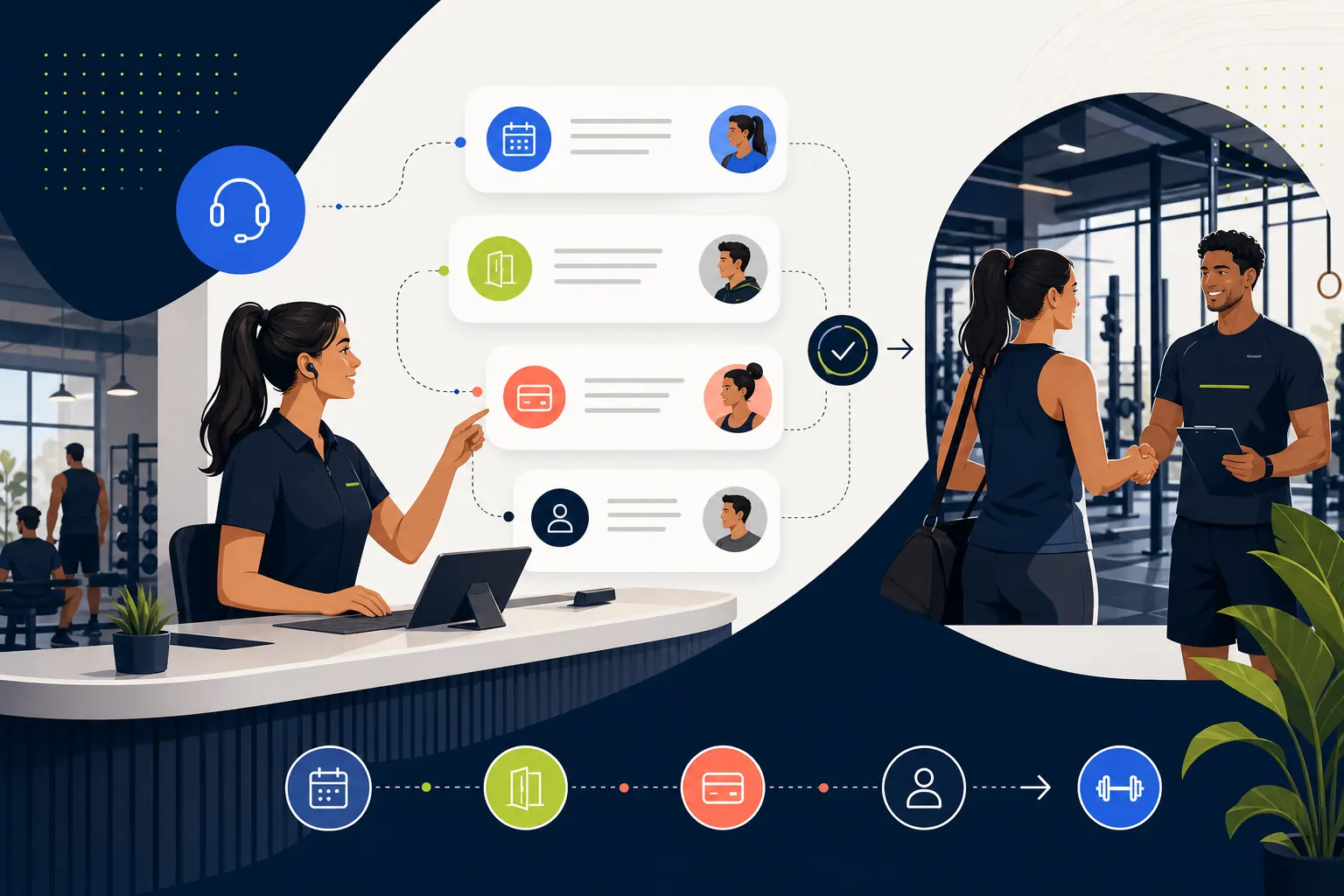
Let reception, sales, billing, and coaching teams share context without turning customer service into professional exercise advice.
Separate commercial interest from service delivery
A conversation may begin with price and continue into a trial, enrolment, access, membership freeze, cancellation, or training question. These topics have different owners, sources, and risks. When they share one undifferentiated queue, members repeat information and teams promise class spaces, terms, or outcomes that have not been checked.
Model separate intents: trial, plan and enrolment, class and schedule, facility access, billing, contract change, and technical guidance. For each one, record the location, current owner, checked system, next action, and due time. A message is resolved only when the condition is confirmed or the handoff is accepted.
- Trial: location, activity, time, and confirmation
- Plan and enrolment: current terms, documents, and secure channel
- Schedule and access: class, capacity, rule, and fallback
- Billing: charge, due date, dispute, and return time
- Technical: assessment, programme, pain, injury, and qualified owner
Draw a boundary around professional activity
Reception may explain opening hours, services, and administrative steps. It should not prescribe exercise, design a programme, assess an injury, interpret a health condition, or promise a body result. Brazil’s Law 9,696/1998 reserves physical-education activities to registered professionals and assigns programme planning, supervision, assessment, and execution to them.
Create objective triggers that stop automation: pain, injury, illness, pregnancy, functional limitation, questions about load or technique, assessment requests, and any possible emergency. When there is immediate risk, prioritise safety guidance and appropriate local services; a commercial chat is not a diagnostic channel.
Do not collect health data just to book a trial
Brazil’s LGPD treats health information as sensitive personal data and establishes purpose, necessity, transparency, and security. For an ordinary trial, name, contact, location, activity, and preferred time may be enough. Do not request diagnoses, reports, body photographs, or medical history for service convenience.
If a legitimate stage requires more information, explain the purpose, use the organisation’s approved process, and restrict access. Free-text notes should capture the operating state — such as “assessment transferred to qualified professional” — without reproducing sensitive detail. Define retention, correction, deletion, and the process for data-subject rights.
- Minimum data for each intent
- An appropriate channel for contracts and payment
- Separate access for reception, billing, and technical staff
- No health detail in operating notes
- An audit trail for plan, billing, freeze, and cancellation changes
Verify membership, class, and policy before replying
Brazil’s Consumer Protection Code requires adequate, clear information and makes an advertised offer binding. Use a dated source for membership price, fees, commitment period, hours, capacity, make-up classes, freezes, and cancellation. If the answer depends on an individual contract, locate the account instead of sending a generic rule that contradicts the member’s terms.
For a full class or blocked access, state the known fact, the action under way, and the next update. Do not close the case as merely forwarded. The destination queue must accept it with enough context to act without asking the member to start again.
Respect consent and message purpose
The WhatsApp Business Messaging Policy requires a provided number and opt-in for subsequent messages. On the Business Platform, business-initiated contacts use approved templates; outside the 24-hour window following the user’s last message, a reply also requires an approved template. Automation must offer a prompt, clear, and direct route to a person.
A class reminder, an administrative payment message, and a promotion are different categories. Record what the person authorised, make opt-out simple, and do not treat a support conversation as permanent permission for campaigns. Every template needs a purpose, owner, version, and retirement rule.
Pilot trials or access, not the entire gym
Start with one location and one repeatable intent. For trials, test available and full classes, rescheduling, a minor, a technical question, opt-out, and handoff. For access, test a found and missing account, temporary failure, a charge under review, and an on-site fallback.
Measure confirmed bookings, attendance, time to resolution, accepted handoffs, unowned conversations, repeat contacts, disputes, and reasons for unavailability. Do not optimise conversion alone: an enrolment based on a wrong promise or disputed charge simply moves cost into operations.
Review a weekly sample with reception, management, and a qualified professional. Correct the source, boundary, or ownership behind failures. The playbook should make the path clear to members and auditable for the team.
Official sources consulted
- WhatsApp Business — Messaging Policy covering consent, the 24-hour window, and escalation
- Presidency of Brazil — compiled General Data Protection Law, including sensitive data
- Presidency of Brazil — compiled Consumer Protection Code
- Presidency of Brazil — Law 9,696/1998 regulating the physical-education profession