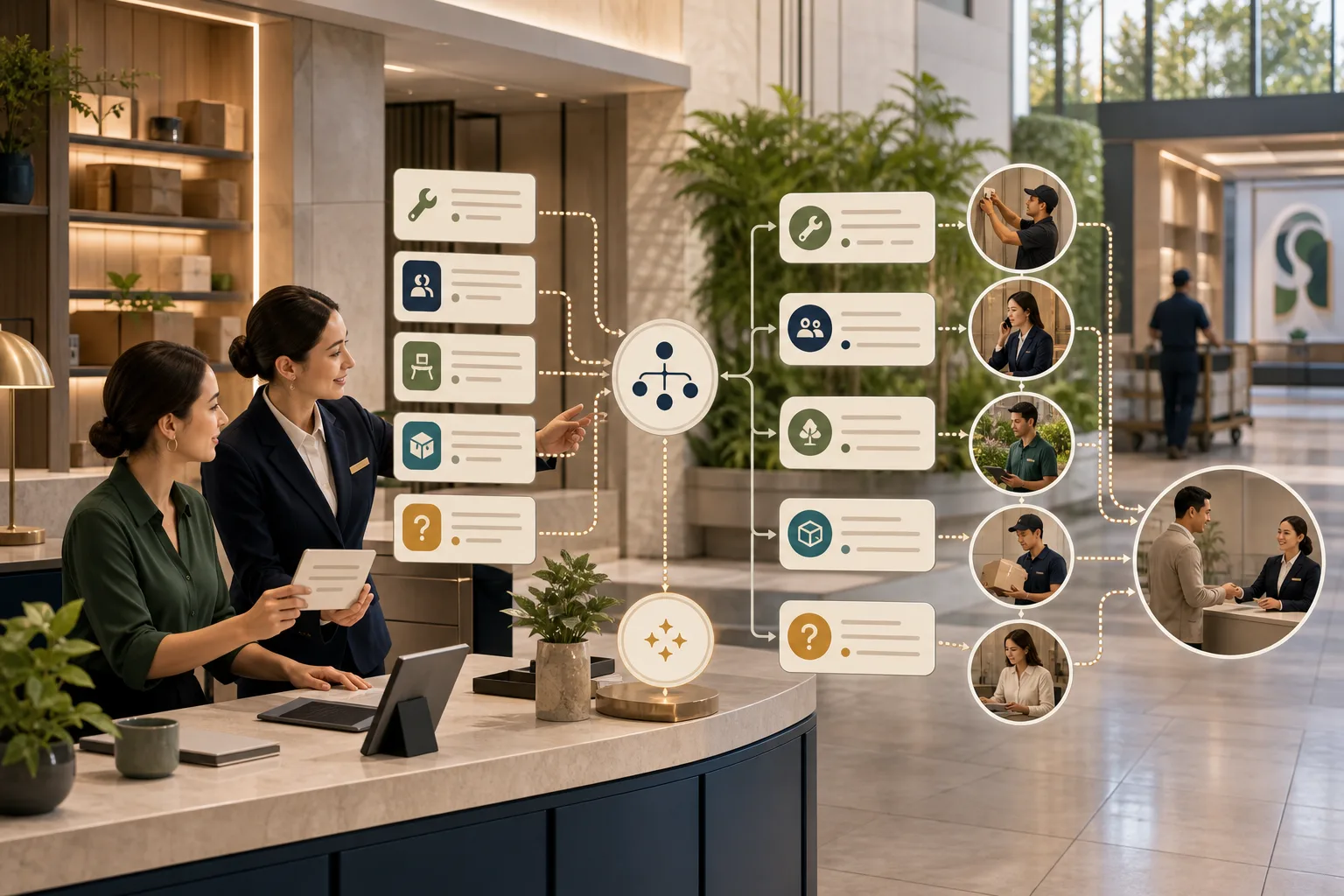
Residents, the property manager, front desk and maintenance team discuss very different issues: a leak, amenity booking, package, visitor, invoice copy, noise complaint, move-in rule or incident in a shared area. If everything reaches one number without a category, urgency, owner and update, each message becomes an invisible promise.
Where AI improves condominium service
AI can answer opening hours and procedures from an approved knowledge base, identify the request and route the conversation. For maintenance, it can ask about location, impact, an optional photo and availability. For amenities, it can explain the process without confirming a slot that was never checked. For packages or visitors, it can point to the official route but must not grant access or disclose another person's data.
| Request | Safe AI assistance | Mandatory boundary |
|---|---|---|
| Maintenance | Collect location, impact, evidence and contact details | Do not diagnose technical risk or promise a visit |
| Rule or opening hour | Answer from approved bylaws, rules or notices | Do not invent a rule or decide a dispute |
| Amenity booking | Explain requirements and query a real integration | Do not confirm without an availability source |
| Visitor or access | State the official process and transfer | Do not authorize entry or reveal a record |
| Possible emergency | Show the official route and immediately alert a person | Do not replace emergency services or promise dispatch |
For threats to life, fire, violence, gas leaks or equivalent situations, the message should direct the person to the appropriate public emergency service or official channel and alert a human under the condominium's real plan. Automation must not imply monitoring or response that does not exist. The guide to AI with human handoff helps establish these boundaries.
The CRM turns messages into trackable cases
The service CRM shows what arrived, who accepted it, what was promised and what remains. It does not need to copy every record from the property-management or access-control systems. It should keep only what is necessary to coordinate the case and reference the official source.
- Contact and unit only when necessary and verified
- Channel, category and original message
- Location, impact, urgency and authorized evidence
- Status, queue, owner, service target and next action
- Source of the rule, decision or availability communicated
- Transfer history and human acceptance
- Privacy, access and retention level
- Outcome, evidence and reason for reopening
Bylaws, house rules, meeting minutes, finance systems, amenity applications and access control remain the official sources. The CRM references the relevant case or status. Biometric information requires heightened care: templates, images and access profiles should remain in the dedicated platform and should not be copied into a chat or general service CRM.
How Signaldesk organizes the solution
Signaldesk brings WhatsApp, Instagram, email and web chat into a shared inbox. Rules can label maintenance, administration, finance, amenities or front-desk requests; AI uses approved knowledge, transcribes voice and summarizes incidents; queues define the team; and the pipeline shows owner, stage and next action. The history follows the case so a resident does not need to repeat everything after each handoff.
Signaldesk can operate as the relationship CRM beside existing property systems. It is not an access-control platform, biometric database, property-accounting package, emergency dispatch center or voting system. It should not modify bank details, apply penalties, interpret bylaws in a dispute or confirm completion without verifiable feedback.
An end-to-end incident workflow
- Intake: preserve channel, timestamp and original message.
- Minimum identification: verify the contact and unit only when the process requires it.
- Triage: AI recognizes category, collects context and detects risk signals.
- Critical route: for emergencies, display official guidance and alert the defined person immediately.
- Case: CRM records owner, target time, next action and privacy level.
- Acceptance: administration, maintenance, front desk or finance takes ownership.
- Execution: the action happens in the appropriate team or official system.
- Update: communicate progress from actual events, not invented estimates.
- Closure: retain evidence, outcome and a simple reopening route.
Use the department-routing playbook to require acceptance and avoid circular transfers. On WhatsApp, collect opt-in, respect opt-out, use approved templates when required and provide a clear human route, supported by the message-template governance guide.
Build privacy into the operation
Privacy rules vary by jurisdiction, but the operating principle is stable: define purpose, minimize collection, restrict access, set retention and protect records. In Brazil, the LGPD establishes those obligations. ANPD Technical Note 54/2025 also listed the condominium sector as an inspection priority, referring to increased complaints and biometric access-control processing. This is an official risk and priority signal, not a new condominium-specific law.
Pilot one category and measure the operation
Start with a lower-risk administrative category, such as non-emergency maintenance. Configure questions, fields, rules, queues, working hours, status messages and boundaries. Test an unverified unit, a photo containing bystanders, a potential emergency, a request for another resident's data, an outdated rule, changed bank details, no owner and opt-out.
Measure first response, unowned cases, handoff acceptance, repeated transfers, overdue next actions, first-contact resolution for administrative questions, reopening, resident updates and backlog by category. Connect these to broader customer service metrics without promising satisfaction or cost reductions before observing real data.