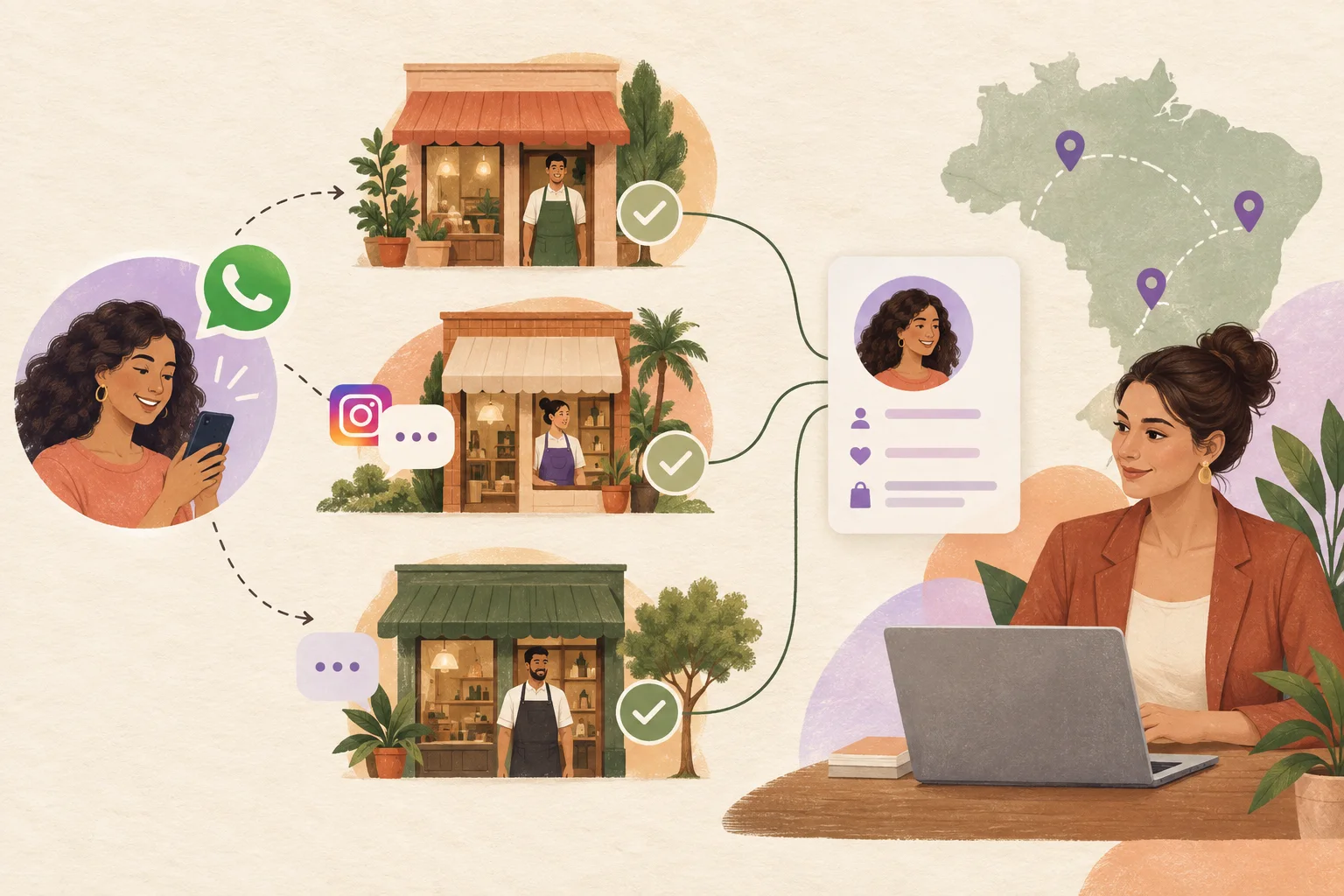
To organize franchise customer service, separate three things: the channel where the customer arrived, the location capable of resolving the request, and the person responsible for the next action. The franchisor defines standards, categories, and escalation rules; the local team receives enough context and remains accountable until completion. Centralization should not remove every local decision. It should prevent customers from disappearing between profiles, phone numbers, and teams.
Design one journey, not a collection of isolated inboxes
Brazil’s Franchise Law describes a model that combines brand rights with implementation and business-management methods. It also requires the franchise disclosure document to explain support, network supervision, services, technology, training, and manuals. The law does not prescribe a customer-service workflow, but it shows why standards and responsibilities must be explicit across the network.
Sebrae recommends an operating system that structures the relationships among franchisor, franchisees, suppliers, and customers, with standardized communication that still respects local differences. Apply that principle to service: use a shared contact-reason taxonomy, a small set of work states, transfer rules, approved sources, and decision limits.
Start with a cross-channel customer-journey map. List where leads, orders, bookings, questions, returns, complaints, and post-sale requests begin. For every step, record the source of truth, the capable location, the deadline, and the outcome that really closes the case.
Route by capability, territory, and context
An automation should not send every conversation to the nearest postal code. A customer may want to buy online, collect in another city, complain about a specific location, or reach the franchisor. Ask only two or three objective questions when the data is not already known: what is needed, which location or region is involved, and whether an order, booking, or case number exists.
| Contact type | Initial destination | Required context |
|---|---|---|
| Local lead | Location serving the region | Source, product or service, city, and reply deadline |
| Order or booking | Location responsible for fulfilment | ID, current stage, applicable promise, and next action |
| Network-level question | Central or specialist team | Topic, location, and relevant history |
| Location complaint | Local owner with defined oversight | Location, evidence, impact, deadline, and escalation |
| Commercial or legal exception | Authorized team | Summary, pending decision, and transfer limits |
Use the WhatsApp routing guide as a base, then add location and territory. Avoid long menus and cascading transfers. If the rules cannot find a trustworthy destination, send the case to human triage rather than a random queue.
Standardize what matters and protect local action
Standardize what protects the experience: tone, minimum data, allowed promises, categories, deadlines, transfers, and closure. Do not force a location to send wording that ignores local stock, schedules, or conditions. A knowledge base should distinguish national policies, regional information, and decisions that belong only to the local unit.
Define three levels. At level one, the location resolves the case within policy. At level two, it needs central approval before promising a price, compensation, or exception. At level three, it immediately transfers risk, privacy, safety, sensitive billing, or disputes between locations. The conversation should keep a visible owner even when another team performs part of the work.
Automation and AI can classify intent, suggest a location, summarize history, retrieve approved content, and remind people about deadlines. They should not silently decide who absorbs a loss, invent availability, or close a complaint without evidence. Start in assisted mode with a controlled AI pilot.
Share only the context that is necessary
A network must decide who can see what. Brazil’s data-protection authority explains that people have rights to information about purpose, duration, responsible parties, and data sharing. In practice, do not copy an entire customer record to every location merely because it belongs to the network. Transfer only the data needed for that purpose and retain records of access and changes.
Use stable identifiers and verifiable signals before joining profiles. A similar name, a shared phone, or a social-media contact is not enough to combine histories. The cross-channel identity guide explains confirmation, human review, reversible merges, and audit trails.
A transfer summary should state who the customer is, how identity was confirmed, which location is involved, what is needed, what has already been said, what promise exists, and when the next action will happen. Do not ask the person to repeat the entire story.
Measure the network without punishing locations
A common dashboard can reveal breaks only when definitions are consistent. Compare locations by reason and complexity, not only by an overall average. Track time to assignment, first reply, queue age, on-time follow-up, transfers without context, repeat contact for the same need, and confirmed resolution.
Separate what is controlled by central teams, local teams, and third parties. An integration delay should not become an unfair agent score; a conversation closed without a next action should not look like resolution. The customer-service dashboard guide turns indicators into daily, weekly, and monthly decisions.
Franchise implementation checklist
- Inventory national and local profiles, numbers, emails, forms, and inboxes.
- Map needs, locations, territories, sources of truth, and authorized decisions.
- Define shared categories, states, owners, deadlines, and escalation rules.
- Configure routing with a safe exit to human triage.
- Separate national, regional, and local knowledge with owners and review dates.
- Limit data and permissions to what each location and purpose require.
- Test leads, orders, transfers, complaints, duplicates, and unavailable locations.
- Review metrics by reason, location, and stage before expanding automation.
The goal is not to make every location look identical. It is to deliver a coherent experience: customers know who is handling the issue, teams receive context, central management can see risks, and every case ends with a verifiable result.