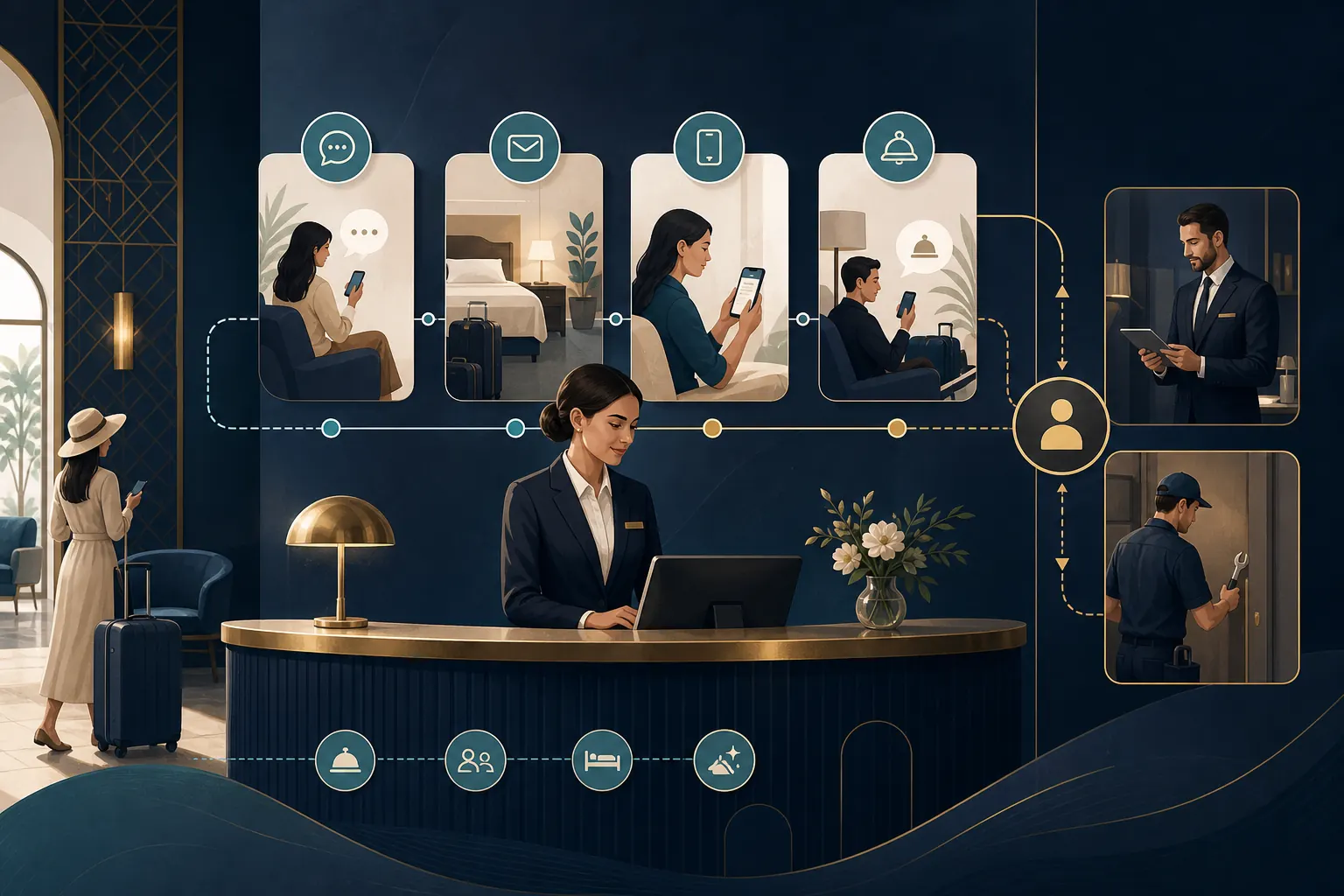
Connect front desk, reservations, and operations so hospitality never becomes an unverified promise.
Design the guest journey, not a list of replies
A guest conversation can begin before booking and continue after checkout. A rate question depends on inventory and commercial terms; a towel request depends on housekeeping; a room-access problem requires priority and verification. Putting every message into one generic queue hides ownership and creates contradictory promises.
Create intents that mirror the journey: enquiry and reservation, pre-arrival, check-in or checkout, in-stay request, maintenance, billing, and post-stay. For each intent, name the source of truth, who may confirm, the response time the team can communicate, and when automation must stop.
- Enquiry and reservation: property, dates, occupancy, room type, and terms
- Pre-arrival: expected time, directions, and declared needs
- Stay: room, request, urgency, and executing team
- Incident: safety, minimum evidence, manager, and update
- Post-stay: billing, lost property, feedback, and follow-up
Verify before promising availability
Service can explain published room types, hours, and services, but it should not turn an estimate into a confirmation. Availability, room category, early check-in, late checkout, parking, cots, and accessibility need verification in the hotel’s adopted system. When another team must answer, say that the request is being checked and set a realistic update.
Brazil’s Consumer Protection Code requires adequate, clear information and makes an advertised offer binding. Operationally, record the rate, dates, occupancy, applicable policy, and exactly what was confirmed. Return material changes in direct language, with a clear option to accept, adjust, or speak to a person.
Use chat to coordinate, not to accumulate documents
Brazil’s LGPD establishes purpose, adequacy, necessity, transparency, and security. Ask only for what is needed to locate a booking and perform the request. Do not request a full card number, an identity-document image, or sensitive information in an ordinary chat when a secure, appropriate workflow exists.
Brazil’s Ministry of Tourism provides the digital National Guest Registration Form with pre-check-in, check-in, checkout, and integration functions. Service can guide the guest into that official process without copying every form field into free-text notes. Keep only the operating state in Signaldesk — for example, secure link sent or check-in pending — and leave full records in the authorised system.
- Minimum booking identifier
- A visible purpose for every requested field
- Secure links for payment or registration
- Role-based access and an audit trail
- Defined retention and deletion periods
Make human handoff part of the service
Automation can publish hours, collect context, and route repeatable requests. It should not decide safety, conflict, unplanned accessibility, suspected fraud, privacy invasion, disputed charges, or compensation on its own. Flag the priority, preserve the original message, and transfer to front desk, security, maintenance, or management.
A transfer is complete only when the destination person or queue accepts it. The summary should contain the intent, property, reservation or room where appropriate, verified facts, commitments already made, and the next update. Record facts and actions, not assumptions about the guest.
Respect consent and the WhatsApp service window
The WhatsApp Business Messaging Policy requires a person to provide their number and opt in to subsequent messages. On the Business Platform, business-initiated messages use approved templates; outside the 24-hour window following the user’s last message, a reply also needs an approved template. Opt-out requests must be honoured.
A booking confirmation, arrival guidance, and a post-stay survey are different purposes. Record the authorised category, keep templates specific, and do not turn an operational update into unexpected marketing. When automation is used, provide the prompt, clear, and direct route to a person required by the policy.
Pilot one stage and measure the complete operation
Start with pre-arrival or in-stay requests at one property. Test booking found and not found, amendments, language, accessibility, unavailable inventory, urgent requests, messages outside the window, opt-out, and handoff. Agents need to know which system to check and who owns the request while confirmation is pending.
Measure volume by intent, first reply, time to confirmation, accepted handoffs, unowned requests, repeat contacts, incidents, and delay causes. Balance speed with quality: a shorter response time does not help when guests repeat information or the team confirms something the property cannot deliver.
Review a weekly sample and correct the source, rule, or ownership behind failures. The target is a verifiable journey: every conversation ends in a real confirmation, a timed next action, or an accepted human handoff.