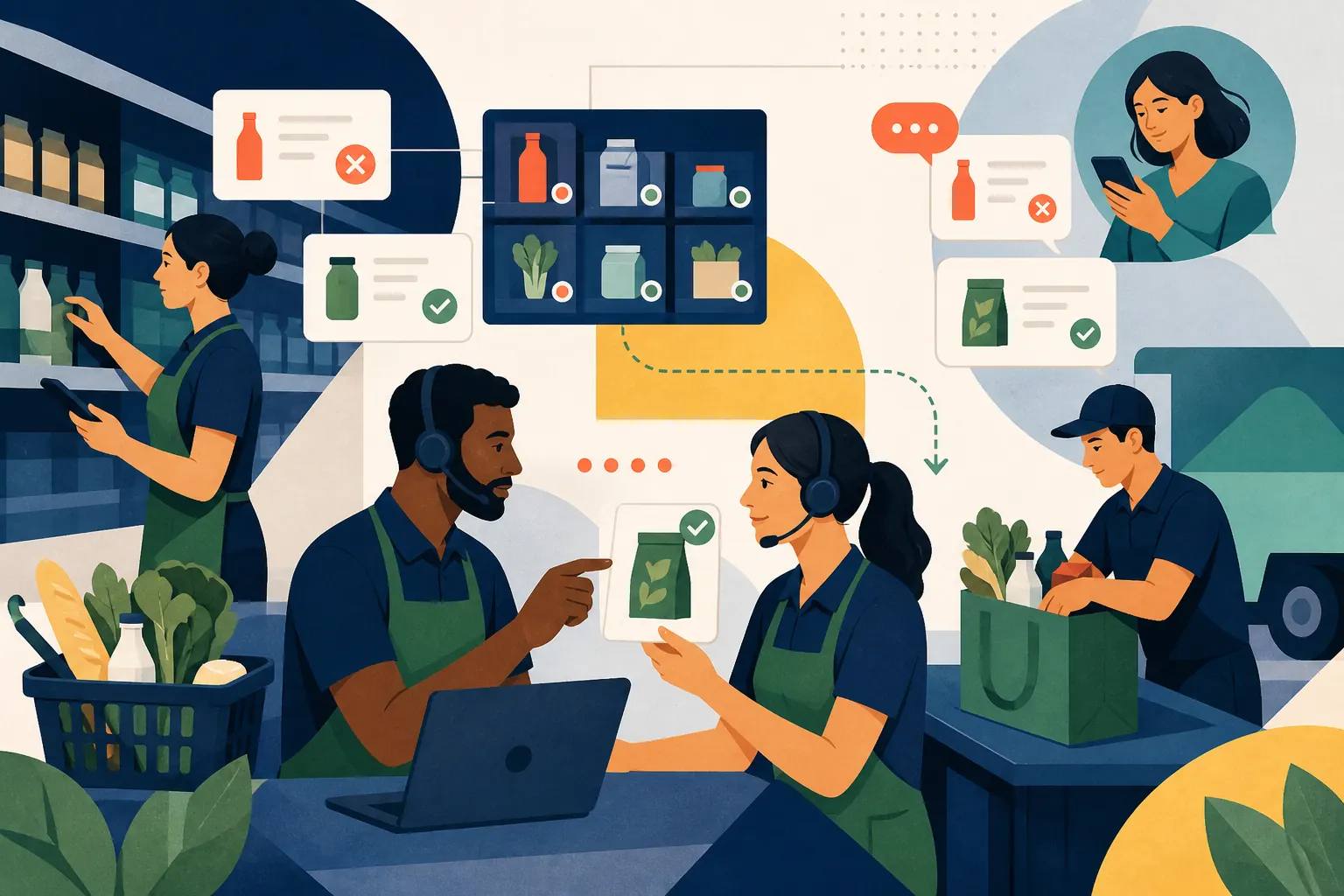
In grocery retail, a fast answer loses value when stock, weight, price, or delivery status has already changed. The playbook must connect every conversation to the correct store and order, distinguish an enquiry from a purchase, obtain an explicit decision for substitutions, and give exceptions a clear owner.
Do not turn an assumption into availability
An agent may consult a current stock source and explain the next step. If that source does not mirror the shelf in real time, the reply should say availability still needs confirmation. A similar product is not an automatic substitute: brand, composition, size, dietary restriction, and price may change the decision.
Brazil's Consumer Protection Code requires adequate and clear information about quantity, characteristics, composition, quality, price, and risks. That supports a simple workflow: show the alternative, material difference, and value before asking for approval; record the choice and preserve the option not to substitute.
Model four grocery workflows
| Intent | Standard action | Escalate when |
|---|---|---|
| Store information | Confirm location, opening time, and available service | Local exception or unverified information |
| Unavailable item | Offer an alternative with differences and price | Restriction, doubt, or no approval |
| Pickup or delivery | State status, window, and next action | Delay, address, damage, or missing order |
| Quality and charge | Record item, batch when relevant, and evidence | Food-safety risk, recurrence, or financial adjustment |
Every conversation needs a queue, owner, state, next action, and due time. “Forwarded” does not end ownership: the transfer is complete only when the new person or queue accepts the case. Department routing turns that handoff into a visible operating rule.
Preserve context without spreading data
Use the order number and proportionate identity checks; do not request full documents for a simple question. Restrict address, payment, and history to people who need them. Anvisa explains that local health authorities license and inspect supermarkets, so food incidents need a defined procedure and owner rather than improvised advice in chat.
- A store-level source for stock and conditions
- Explicit substitution and no-substitution rules
- A record of customer approval
- Permissions for order, address, and adjustments
- An urgent queue for possible food-safety risk
- Ownership for delays, damage, and missing items
- Recurring-cause review by store and supplier
Respect expectations, consent, and the service window
The WhatsApp Business Messaging Policy says a business may only contact people who provided their number and opted in to subsequent messages. Opt-out requests must be honoured. On the Business Platform, business-initiated messages use approved templates; outside the 24-hour window after the user's last message, replies also require an approved template. When automation is used, the policy requires a prompt, clear, and direct route to a person. Record the authorised message category, explain its purpose, and connect the workflow to template governance.
Pilot substitutions and delivery exceptions
Start with one store and pickup or delivery orders that already have reliable states. Define when to offer an alternative, how long to wait for a decision, and what happens when the customer does not reply.
Start with one location, shift, or high-volume intent. Test normal cases, missing information, unavailability, disputes, opt-out, and transfers. Supervisors should review a sample of real conversations and correct the source of each failure, not merely rewrite the final reply.
Measure substitutions offered, accepted, and declined; orders completed without repeat contact; delays by cause; adjustments; unowned conversations; and time to communicate an exception. Do not let one aggregate rate hide differences between stores, shifts, or partners.
Measure volume by intent, first reply, time to resolution, accepted transfers, unowned conversations, repeat contacts, and exception causes. Use consistent customer-service metric definitions, and do not reward fast closures that leave the problem unresolved.