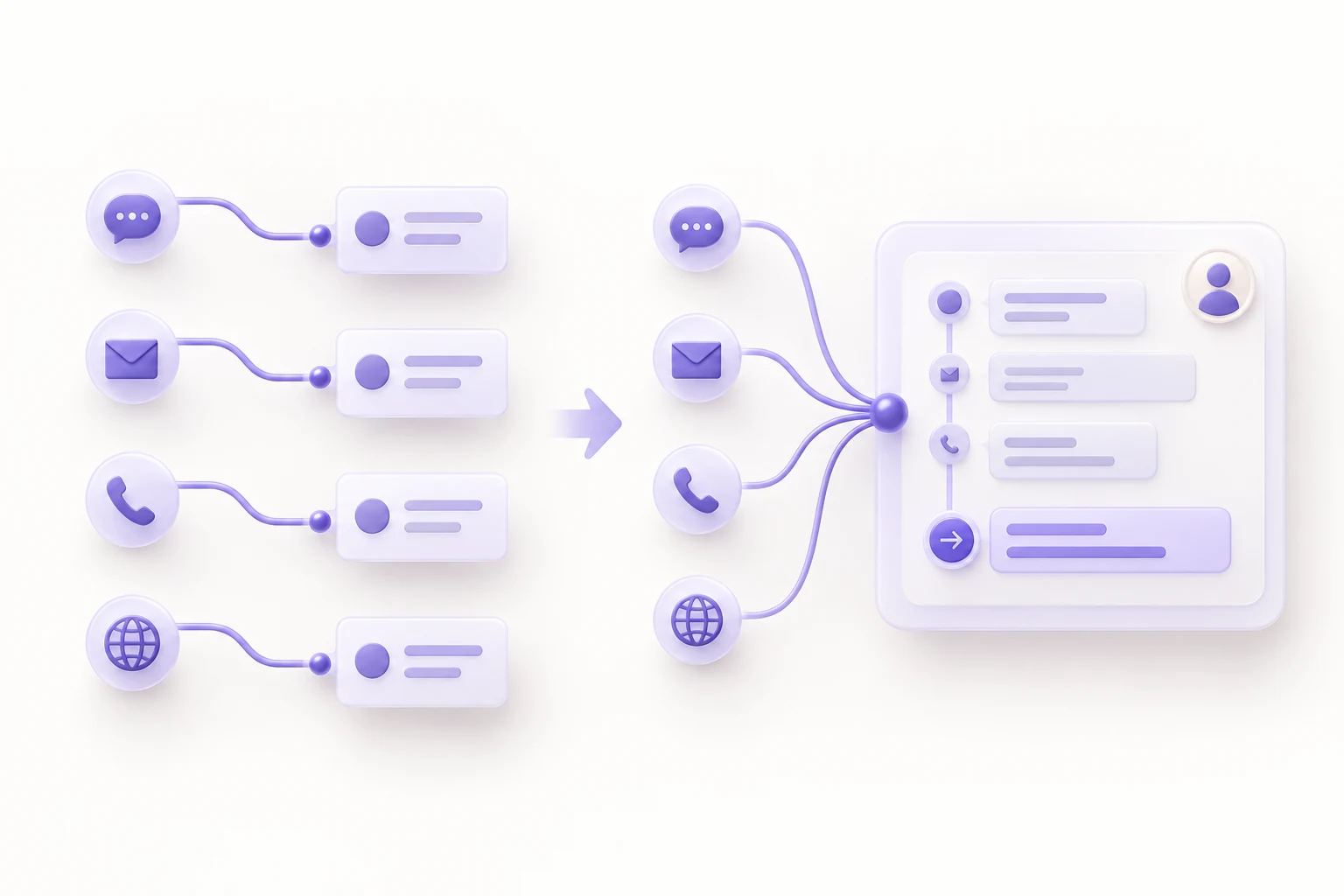
The difference between multichannel and omnichannel service is not the number of channels. A multichannel business offers several contact points, but each one may keep its own queue, history, rules, and metrics. An omnichannel operation coordinates those channels: the team recognizes the customer, preserves available context, distributes work through shared rules, and follows the case through the next action or resolution.
The difference appears in the work, not the channel menu
A company can advertise four channels and still run four islands. A customer asks a question on Instagram, sends details through WhatsApp, confirms by email, and opens web chat because no answer arrived. If each team sees only its own inbox, the business can create duplicate answers, conflicting priorities, and repeated requests for information. That is fragmented multichannel work even when each individual channel performs well.
Omnichannel operations define common rules for intake, identity, queues, priority, assignment, transfers, and closure. Microsoft documents unified routing as a consistent way to classify and assign work from all channels based on work requirements, skills, availability, and capacity. AWS describes shared routing, management, and analytics across channels, including preserved interaction history when a different agent continues the case.
Those examples point to the core idea: omnichannel is an operating discipline. A single screen helps, but it does not automatically repair duplicated identities, incompatible policies, or unclear ownership. The process and the technology have to change together.
Compare what happens to the conversation
| Criterion | Multichannel | Omnichannel |
|---|---|---|
| Intake | Each channel receives and organizes contacts | Entries follow coordinated classification and queue rules |
| History | May stay separated by tool or team | Is consolidated or referenced in a common timeline |
| Owner | Defined inside each channel | Visible for the case even when the channel changes |
| Transfer | Often depends on manual forwarding | Carries context, reason, owner, and next action |
| Priority | May differ among inboxes | Uses comparable criteria across queues and channels |
| Metrics | Describe performance per channel | Can describe channel, journey, and case outcome |
Do not read the omnichannel column as an automatic quality guarantee. Results depend on configuration, supported integrations, and team discipline. Ask every provider which channels are genuinely integrated, which events appear in history, how duplicates are handled, and what happens when an integration fails.
When multichannel still makes sense
Multichannel is not automatically a mistake. A small business may keep email for administrative questions and WhatsApp for sales without needing to join the two journeys. Channels with entirely different audiences, risks, or teams may also remain separate. The useful question is whether separation creates material cost or risk.
The case for change appears when customers regularly cross channels, the same request moves between sales and support, agents need several screens to answer, managers cannot see which conversation has no owner, or channel-level metrics do not explain the final outcome. In those cases, integration should follow the real customer journey, not the easiest order for connecting tools.
Run a simple continuity test
Select ten recent cases in which a customer used more than one channel. For each one, ask: did the team recognize the same person? Did the second agent see the reason and earlier decisions? Was there one clear owner? Did the next action have a due time? Did the customer repeat information? Were any answers duplicated or contradictory?
Then draw the contact timeline. Mark every change of channel, system, team, and owner. The point where the story must be rebuilt is the strongest candidate for the first omnichannel workflow. Pair this review with the guide to mapping customer journeys across channels and the rules for linking customer identities without false merges.
Migrate in phases and keep a fallback path
Start with one high-volume or high-impact workflow, such as a quote request that begins on Instagram and moves to WhatsApp. Define which events enter the shared view, which system is authoritative, who receives the case, which fields are required, and when the transfer is complete. Import only the history that is necessary and tested.
Run a pilot with a small team. Compare time to assignment, ownerless cases, repeated context, repeat contacts, and answer quality. Keep a contingency plan for service when an integration stops. The omnichannel migration checklist covers inventory, pilot, cutover, and reconciliation.
AI can summarize conversations, suggest a reason, and prepare the next response, but it must work from correct data and defined limits. When identity or context is uncertain, automation should ask for confirmation or hand off to a person, not join histories because they look similar.
A checklist for choosing without buying a promise
- List active channels and the purpose of each one.
- Identify journeys that cross two or more channels.
- Measure repeated context, transfers, and ownerless cases.
- Define the authoritative source for identity, history, and status.
- Confirm integrations, limitations, failures, and export options with the provider.
- Select one pilot workflow with an owner and success criterion.
- Test routing, permissions, transfers, and contingency.
- Review real conversations alongside metrics.
- Expand only after the first workflow proves continuity.
The best choice is not the architecture with the largest number of channels. It is the smallest change that preserves context, makes responsibility visible, and lets the team complete the next action without depending on the customer's memory.