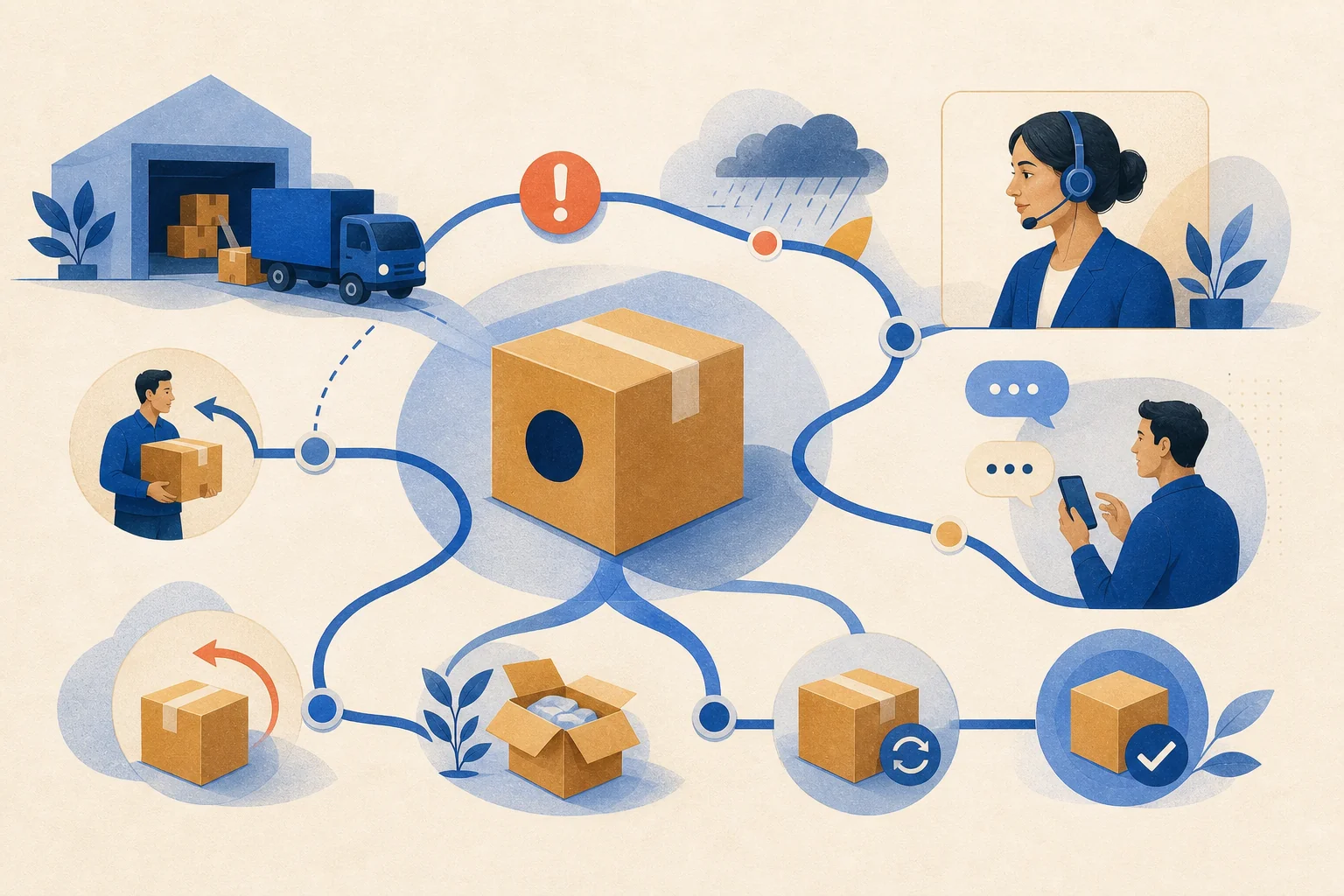
Customers ask in natural language; operations answer with states. A strong playbook connects intent, order, action, and next deadline.
Do not confuse order states
Ecommerce platforms distinguish overall, payment, fulfilment, and return status. Shopify documentation shows that an order can be open, paid, partially fulfilled, and have a return request at the same time. Agents need to say which dimension they are explaining.
Before promising action, confirm the order and identity using the company’s minimum-data rule. Do not ask again for information already present in history. Show the current state, available evidence, and next expected event.
Four essential flows
| Intent | Data | Safe outcome |
|---|---|---|
| Where is my order? | Order and fulfilment status | State, tracking, and confirmed next date |
| It is late | Promise, carrier event, and exception | Explanation, open action, and follow-up |
| Exchange or return | Item, delivery, eligibility, and current rule | Instruction or human review |
| Payment | Status, attempt, and method | Guidance without exposing sensitive data |
Create exception paths
Automate lookup and collection when data is reliable. Hand off delivery disputes, suspected fraud, damage, policy exceptions, chargebacks, and refund approval. A return may include request, approval, inspection, restocking, and refund; do not treat those steps as synonyms.
- Identifies the correct order and item
- Names the state being consulted
- Separates information from a promise
- Records action, owner, and follow-up date
- Does not invent a return policy
- Preserves context during handoff
- Closes only when the next step is clear
Learn from demand
Group contacts by reason and order stage. Repeat delivery questions may reveal unclear transactional messages; misrouted returns may reveal a hard-to-find policy. Connect the playbook to the knowledge base checklist, department routing, and resolution metrics. Avoid commercial outcome claims; use conversations to repair observable processes.
Turn this guide into an operating routine
Start with a small, observable pilot for “Ecommerce customer service: order, return, and delay playbook”. Select one team, one channel, and a defined period. Record the baseline: volume, queue age, ownership, exceptions, and complaints connected to the process. Then write a short rule, name the decision owner for ambiguous cases, and document how to return to the previous flow if something fails. This design prevents an unmeasured broad rollout and creates a fair before-and-after comparison.
- An operating objective stated as one verifiable sentence
- An execution owner and a supervisor for the review
- A conversation sample covering normal cases and exceptions
- Start date, duration, and a fallback rule
- A primary metric, a safety indicator, and event sources
- A final decision: keep, adjust, expand, or retire
During the pilot, review real conversations rather than trusting the dashboard alone. Confirm that state, owner, history, and next action match what the customer experienced. Separate process failure, tool limitation, integration failure, and execution error; each cause requires a different correction. At the end, publish the approved rule where the team works, retire old instructions, and schedule another review. The desired result is not only a better number. It is an operation that can explain why performance changed and reproduce the improvement without depending on one particular person.